
The Road to the Kentucky Derby makes a stop at Oaklawn Park on Saturday, with the running of the $1.25 million dollar, Grade 2 Rebel Stakes.
This 1 1/16-mile event typically draws a deep, competitive field, buoyed by a massive purse plus 50 qualifying Derby points going to the Winner.
The race was inaugurated in 1961 as the Rebel Handicap, and was changed to the Rebel Stakes in 1984. That same year, the distance was adjusted from one mile and 70 yards to 1 1/16 miles.
In 1990, the race was given Grade 3 status, but was ungraded in 2003 and 2004. It was upgraded to Grade 2 in 2008.
In recent years, this race has seen dramatic purse increases. In 2011, the race carried a purse of $300,000. By 2016, the purse had tripled to $900,000. It was held as a $1 million race for the first time in 2020 and increased again by a quarter of a million dollars in 2024.
Here’s a look back at three the best Winners of the Rebel Stakes in the 21st century:
SMARTY JONES (2004) In his first Oaklawn start, SMARTY JONES Won the Southwest Stakes by three-quarters of a length. Although he entered the Rebel Stakes undefeated he did not command that much respect at the betting windows. He was the 7-2 third choice behind the much-hyped PURGE and a Fairgrounds shipper MR. JESTER.
PURGE went to the lead, while jockey Stewart Elliot rated SMARTY JONES just off the leader’s flank in 2nd. As the field rounded the far turn, PURGE held a narrow advantage but SMARTY JONES continued to edge closer. PURGE had no response in the last eighth, and SMARTY JONES pulled away for a 3 ¼-length victory.
Following a dominant Win in the Arkansas Derby, SMARTY JONES went to Louisville as the Kentucky Derby favorite, with a shot to become the first undefeated Derby Winner since SEATTLE SLEW in 1977. On a sloppy track he did just that, as he wore down pacesetting LION HEART for a 2 ¾-length Victory.
SMARTY JONES then Won the Preakness Stakes in dominant fashion, setting himself up to become the first Triple Crown Winner in 26 years. A 120,000 strong, showed up to Belmont Park for the Belmont Stakes to cheer on the popular Pennsylvania-bred. Alas, he lost to the late-running upset Winner BIRDSTONE in one of the most memorable Triple Crown races of this century.
______________________________________________________________________________________
CURLIN (2007) CURLIN was on the national racing scene from the moment he made his debut. He Won his first start at Gulfstream Park in February 2007 by 12 ¾ lengths, going seven furlongs in 1:22.25.
CURLIN was jumped up in class for his second start but still went off as the second betting choice in the Rebel Stakes. Against a tougher field and stretching out around two turns for the fist time, he was just as impressive. He made a big, four-wide sweep on the turn and powered away in stretch for a dominant 5 ¼-length Win. At that moment, CURLIN became one of the Kentucky Derby favorites.
In his final tune-up for the first Saturday in May, CURLIN Won the Arkansas Derby by 10 ¼ lengths. Despite not racing at age 2 and with only three starts under his belt, CURLIN was the 5-1 second choice in the Kentucky Derby. He finished 3rd behind STREET SENSE, but avenged that defeat with a Win in the Preakness Stakes. CURLIN then lost a thrilling Belmont Stakes to the filly RAGS TO RICHES, but later that year he Won the Jockey Club Gold Cup and the Breeders’ Cup Classic to clinch the Horse of the Year title.
As a 4-year-old in 2008, CURLIN added another Horse of the Year title to his résumé, notching four Grade or Group 1 Wins. He also became the first American-based horse to pass $10 million in career earnings.
______________________________________________________________________________________
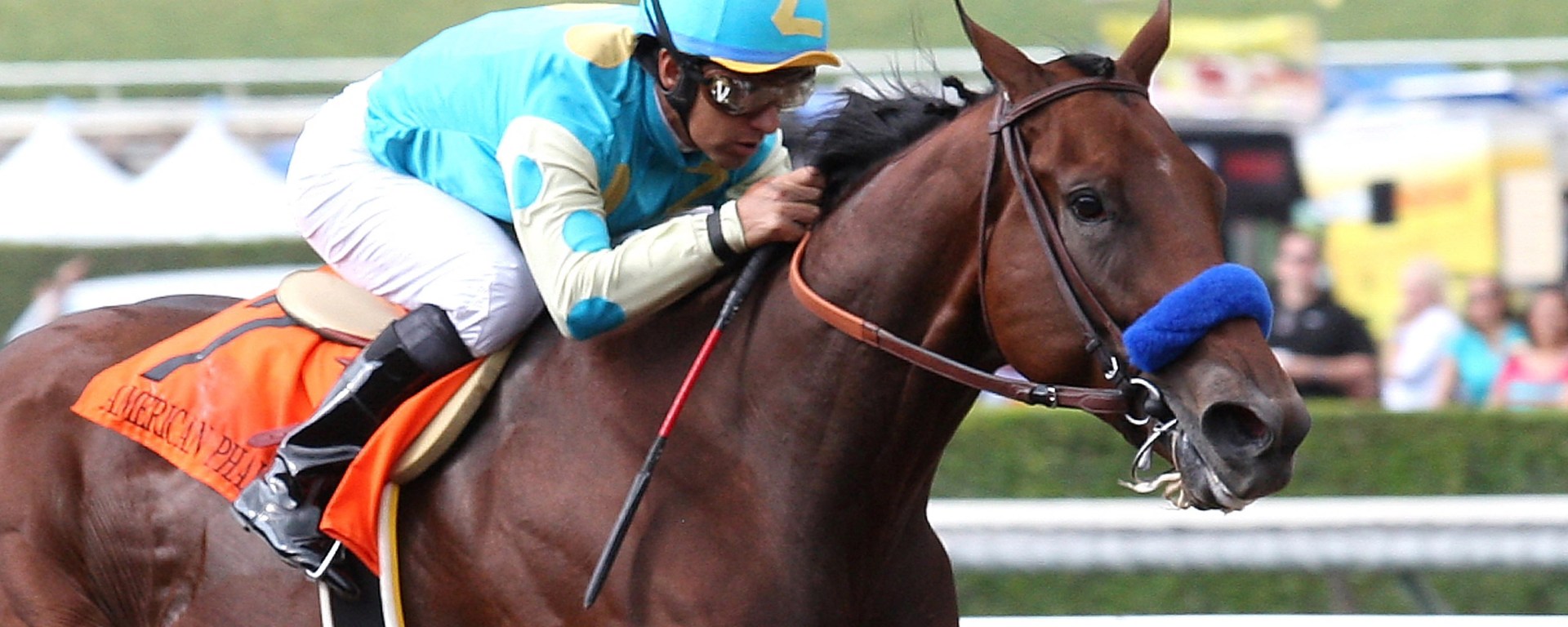
AMERICAN PHAROAH (2015) Despite not racing in the Breeders’ Cup, AMERICAN PHAROAH was voted champion 2-year-old male of 2014 based on two Grade 1 Wins in California. He made his 3-year-old debut in the Rebel Stakes, where he was made the overwhelming 2-5 favorite in the field of seven.
AMERICAN PHAROAH recovered quickly from a bad break and went immediately to the front. By the time he reached the opening quarter, he was 1 ½ lengths in front and setting very moderate fractions. None of his rivals would bother catching him and he opened up more and more with every stride. On a very sloppy track, he crossed the finish line 6 ¼ lengths clear of the others, stopping the clock in 1:45.78.
The Rebel proved to be a harbinger for an awe-inspiring campaign. That summer, AMERICAN PHAROAH swept his way through the Triple Crown, becoming the first horse to Win the three jewels since AFFIRMED in 1978. And just for fun he completed his year with a dominant Breeders’ Cup Classic Win. With that victory, he became the first horse since UNBRIDLED in 1990 to Win the Kentucky Derby and the Breeders’ Cup Classic in the same year.

